Planning paths that survive a changing world
Two global planner plugins for ROS2 Nav2, written in modern C++20: classic A* and incremental D* Lite, benchmarked head to head on one event: an obstacle lands on the route and the planner must recover.
The problem
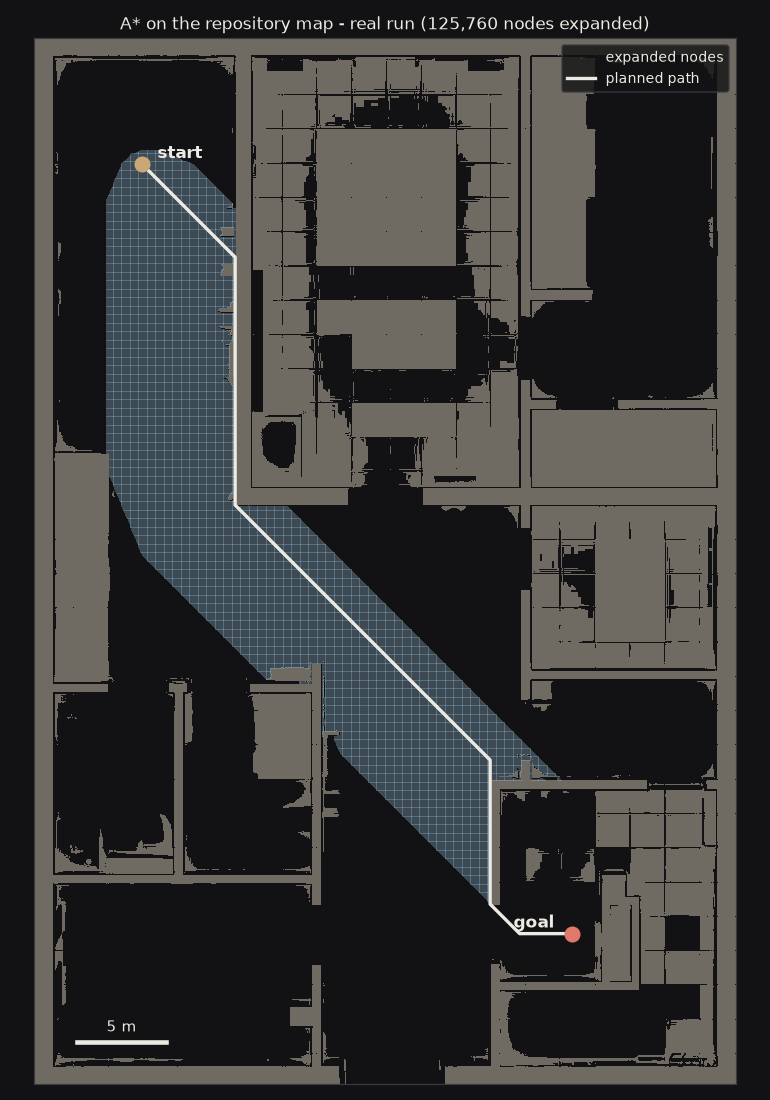
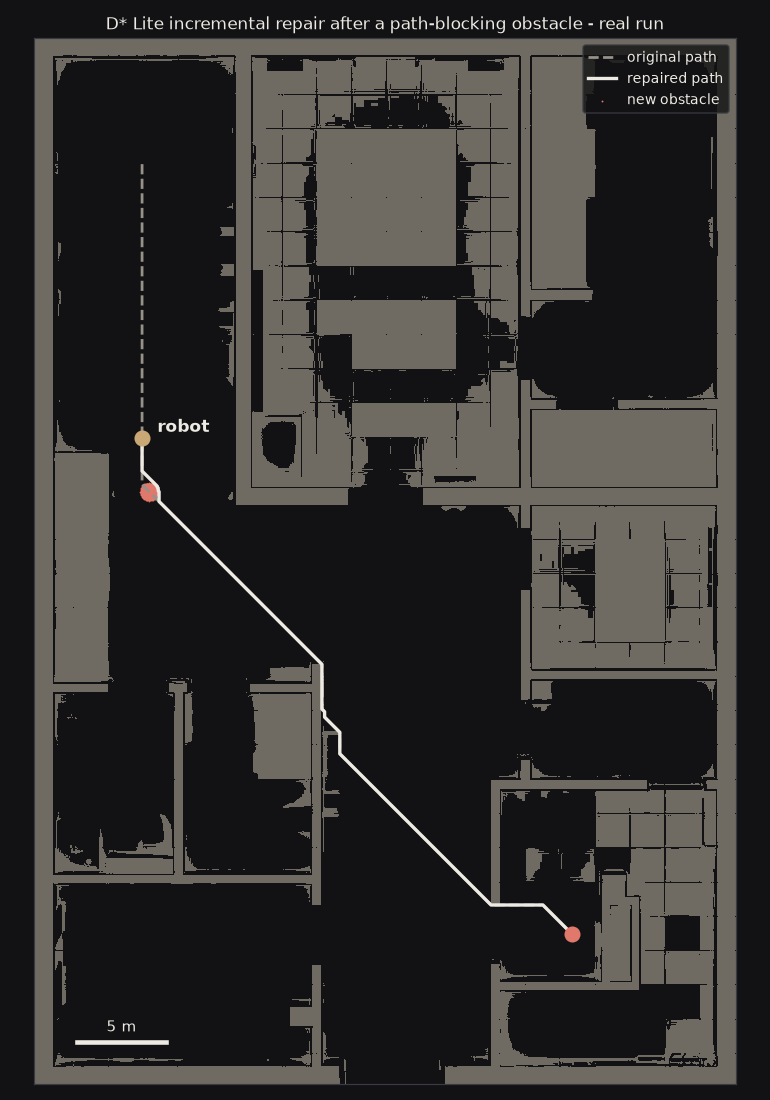
Warehouses, hospitals, and homes never hold still. A robot plans a route, someone steps into it, and the plan is suddenly wrong. Classic A* handles this by throwing everything away and searching again from scratch, which costs processing spikes exactly when smoothness matters most. D* Lite takes the other road: it repairs the existing plan incrementally, reusing everything the previous search already learned.
This project turns that textbook comparison into running code: a ROS-free C++20 planning core with Nav2 plugin adapters, and a benchmark whose numbers a stranger can reproduce: the per-event data, the seed, and the code that produced them are committed together, and CI re-runs the tests and a benchmark smoke pass on every push.
Getting D* Lite correct was the hard part: its priority keys routinely tie between vertices, and floating-point rounding of mathematically equal keys can bury a vertex the algorithm must expand, freezing stale state into the path. The fix is an exact integer cost metric (every g, rhs, and key an integer, every comparison exact), validated by 185,237 fuzzed incremental replans that must match a reference Dijkstra to the unit.
What the planner sees
The results
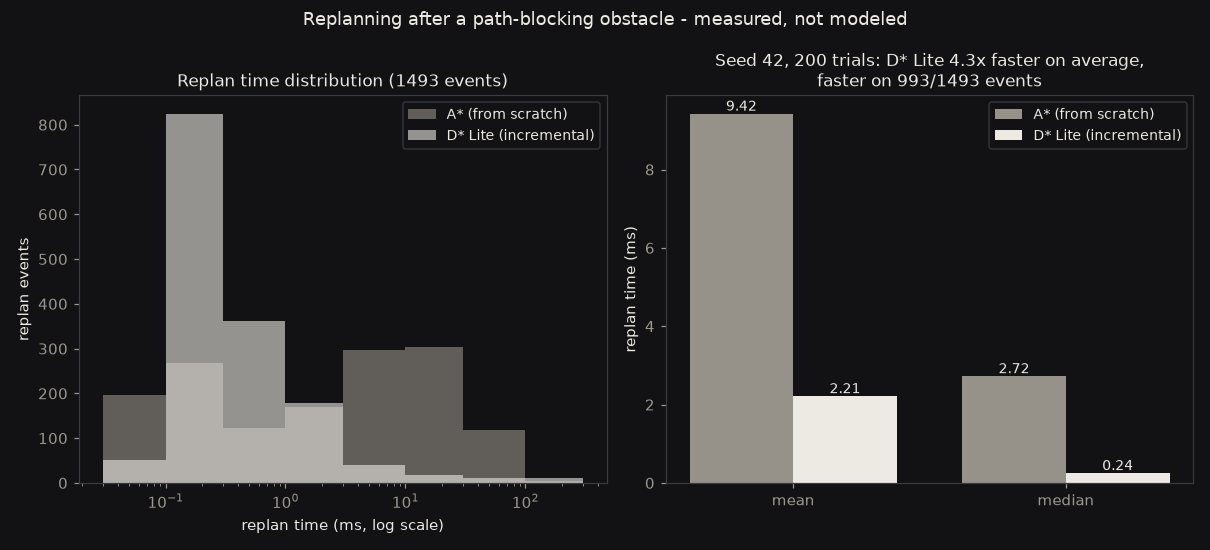
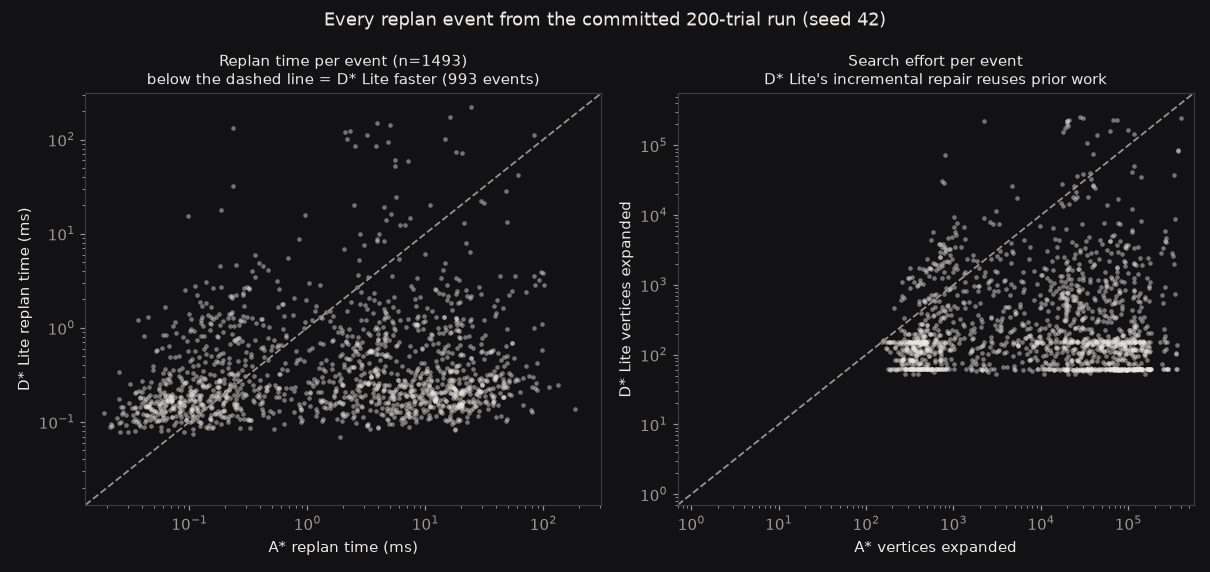
What makes the comparison fair: both planners face byte-identical scenarios, obstacles are injected on the current path so the change always matters, measurement order alternates to cancel cache effects, and both planners optimize the same exact cost metric, so the zero cost-mismatch count means the race is between two optimal planners. The trade-off: D* Lite pays a ~2.7x costlier initial search and loses trivial replans; it wins where the from-scratch search is expensive, which is where a CPU spike costs a robot most.
Under the hood
- ROS-free C++20 planning core; A* and D* Lite (Koenig & Likhachev, persistent search state, correct km accumulation)
- Exact integer cost metric, the fix for D* Lite's floating-point key-tie failure mode
- Tests validate both planners against reference Dijkstra with exact equality; the incrementality property itself is asserted in CI
- Nav2 global planner plugins over the tested core; build-verified against ROS2 Humble in CI
- Every figure on this page rendered from committed run data by a committed script