Open to PhD & engineering opportunities
ROBOTICS & AI RESEARCH ENGINEER

Teaching robots to say what they mean, and to know when they can't.

I build the systems that make robots worth trusting. Benchmarks that prove how LLM planners fail. Verifiers that stop unsafe plans before hardware moves. Humanoids that communicate their intentions clearly.

MSc AI & Robotics (Commendation) · University of Hertfordshire

116 of 120
Trajectories the models called legible, including all 25 that were impossible
32 of 32
Certified legibility bounds holding, zero violations, submitted to IEEE RA-L
2
Robot platforms deployed on, JD humanoid & Unitree Go1
01 ABOUT

Engineer first. Researcher by conviction.

I work at the boundary between robotics research and shipped engineering. My academic work asks how humanoid robots should communicate so that people trust them appropriately, not too little, not too much. My applied work has been building the embedded systems and edge AI pipelines that make robots, and the products around them, actually work in the field.

That combination shapes how I think about every project: a result only matters once it survives contact with real hardware, real users, and conditions nobody designed for in the lab. I bring the same standard to a fresh dataset on a humanoid platform as I do to firmware shipping in a safety-critical product.

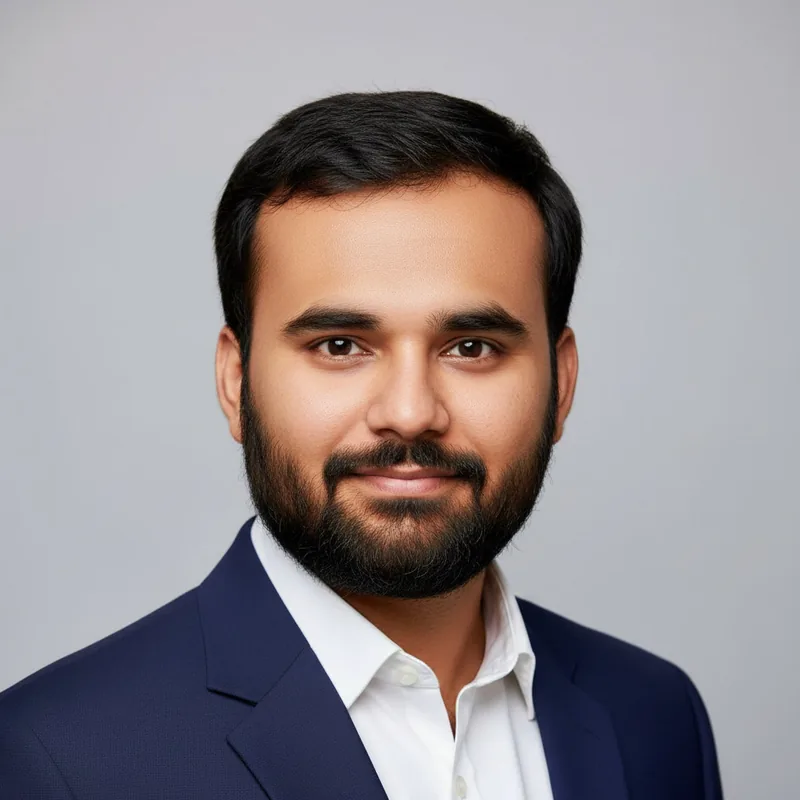
Portrait of Munawar Kazmi

MSc AI & Robotics

Commendation · University of Hertfordshire · 2023-2024

BEng Mechatronics Engineering

NUST · 2018-2022
02 NOW

On the bench right now

Active research, updated as it lands. The latest commit is fetched live from GitHub, so the freshness claim checks itself.

legible-motion-bench

A benchmark that measures legibility against path cost against constraint satisfaction, computed exactly, with no human rater and no model judge anywhere in the loop. Asked to plan in the same worlds, three language models claimed legibility for 116 of 120 trajectories, including all 25 that were not physically possible. Three models at one temperature is a pilot, not a finding. Next on the bench: whether this metric tracks what people actually perceive.

Four planners moving through the same room on one clock: the shortest path stays clear of a hatched keep-out zone while three legibility-optimised trajectories cut through it, with bars beneath each panel showing the watching observer's belief in each goal
One world, four planners, one clock. The shortest path avoids the hatched keep-out zone and leaves the watcher guessing; the three legible trajectories commit early and cut straight through it. The bars are the observer's belief, and they are the same numbers the tables are computed from rather than a second drawing of them.
The model pilot, measured
Asked the same question, three language models
Over 40 decodes eachQwen 2.5 7BLlama 3.3 70BGemini 3.6 Flash
called legible by the model404036
physically possible262940
clearer than the shortest path102030
over the stated path budget9150
entered a keep-out zone770

116 of the 120 decodes claimed to be legible, including all 25 that were not physically possible. The stated path budget is a constraint for one model and text for the other two: the third threads a route at 1.08 to 1.11 times the optimal path cost and enters no keep-out zone, while the other two return the same modal trajectory whatever budget the prompt names. Three models at one temperature is a pilot, and the founding paper already notes that legibility pushes trajectories towards obstacles, so this narrows existing work rather than opening new ground. The frontier table and the budget sweep →

legibility-bounds

The benchmark above measures what a planner achieved. This certifies what nothing could achieve: an upper bound that quantifies over every admissible trajectory rather than the ones somebody tried. All 32 world and budget pairs hold with zero violations, and the narrowest gap anywhere is 0.0064. Six pages, submitted to IEEE RA-L in August 2026, preprint at DOI 10.5281/zenodo.21834955. Next: where the remaining width in obstacle worlds actually lives.

Certified legibility intervals for eight worlds: each band runs from a circle marking a trajectory that exists to a diamond marking a bound nothing can exceed, with the shortest path marked separately for contrast
Every band is a certified interval. The circle is a trajectory that exists, the diamond is a wall nothing can cross, and the tick is the shortest path for contrast. The optimum lies inside every band, and no bound is violated.
The certified intervals
The widest interval in each world
WorldBudgetAchievedBoundGap
fan_middle1.250.43430.49090.0567
narrow_gap1.500.75840.80410.0456
fan_outer1.100.64100.66920.0282
door_pair1.500.85070.87760.0269
wall_choice1.100.57870.59150.0128

All 32 world and budget pairs hold, with zero violations. Each row shows the world at the budget where its interval is widest, and the narrowest gap anywhere is 0.0064. The upper end quantifies over every admissible trajectory rather than the ones somebody tried, so no better optimiser weakens it; the lower end is constructed rather than searched for, and beats the vendored local search in 13 of 32 cases, by up to 0.1485.

One claim here has been withdrawn. A loose constant in the obstacle argument was named as the highest-leverage improvement outstanding and then sharpened, and it was worth 1.6 per cent; but its looseness had been measured against the wrong quantity, and corrected it never binds in any world tested. So where the width in obstacle worlds lives is open again. The honest ceiling on all of it: the observer model is exactly reproducible and has never been validated against people, so these are certified bounds on a stated objective, not on what a human watching would actually infer. The full argument →

03 FEATURED RESEARCH

Two research lines: reliable planners, legible robots

How language model planners fail, measured against machine-checked ground truth; and how humanoid robots should communicate so people can calibrate their trust.

Symbolic environments · PDDL · 4 LLMs · CI-proved labels

plan-failure-bench: A Machine-Checkable Benchmark of How Language Model Planners Fail

Sole author · Working paper · DOI 10.5281/zenodo.21756817
Three confusion matrices on the same 30 instructions: Qwen 2.5 7B sends nearly every trap to precondition violation, Gemini 3.1 Flash Lite splits between walking in and calling them infeasible, and Gemini 3.6 Flash produces the ideal diagonal
Same 30 instructions, three failure shapes: the smallest model walks into nearly every trap, the mid-tier model splits between walking in and declaring them infeasible, and the frontier model answers the ideal diagonal. Label proofs in, one verdict per response out, no judge anywhere. All eighteen runs, and the pipeline that produced them, are on the story page.

Every instruction either admits a valid plan or plants exactly one trap, and every ground-truth label carries a mechanical proof re-verified in CI on each commit. A deterministic checker, differentially tested against an independent PDDL toolchain, scores every response with no human or LLM judge anywhere, and detection is never reported without its paired false positive count. The headline artefact is the confusion matrix between planted trap and observed verdict.

Across an 18-run grid over four models, the models fail in distinct, stable ways: a frontier reasoning model survives full semantic obfuscation on both environments, one sequencing seed short of perfect, while smaller models split between silent compliance and surface-anchored refusal.

60
Instructions, each with a machine-checked proof of ground truth
18
Complete model runs, every record committed
548
Tests and label proofs, re-run on every commit
0
Human or LLM judgements in the scoring loop
JD Humanoid · Isaac Sim · ROS2

Enhancing Human-Robot Companionship: Comparing Verbal and Non-Verbal Communication Cues in Humanoid Robots

MSc Thesis · University of Hertfordshire · Supervised by Dr Patrick Holthaus
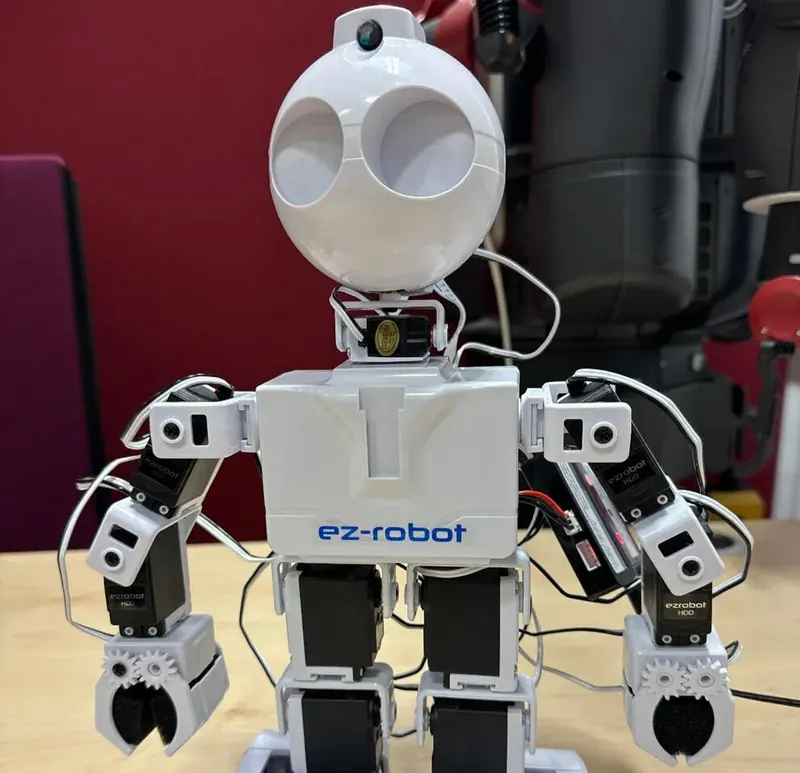
JD humanoid robot platform used in the trust-calibration study
JD humanoid · EZ-Robot · the study platform

A full sim-to-real pipeline on the JD humanoid, from an Isaac Sim digital twin through ROS2 hardware integration, built so that a gestural and a spoken condition could be delivered identically to 20 participants. Counterbalanced, RoSAS-validated, under UH ethical approval cSPECS/CL/UH/05098. The scenario was deliberately mundane: the robot had to communicate that it needed recharging.

Speech conveyed intent significantly more clearly than gesture, while engagement and warmth held comparable across both. Every gestural failure was a failure of joint attention rather than of communication, which is why the design target is hybrid rather than either one alone.

d = 0.58
Effect size, clarity: verbal vs. gestural (p = 0.017)
95%
Intent identification accuracy, verbal condition
80%
Intent identification accuracy, gestural condition
N=20
Within-subjects, counterbalanced, RoSAS-validated
04 PUBLICATIONS

Research output

Enhancing Human-Robot Companionship: Comparing Verbal and Non-Verbal Communication Cues in Humanoid Robots

Kazmi, M. (2025)
MSc thesis research · University of Hertfordshire · N=20, within-subjects, counterbalanced, RoSAS-validated
Read the paper (PDF) →
Read the paper →

plan-failure-bench: A Machine-Checkable Benchmark of How Language Model Planners Fail

Kazmi, M. (2026)
Working paper, updated as the research completes · results tables generated from the committed records · DOI 10.5281/zenodo.21756817
Read the draft →

Certified Bounds on Achievable Legibility under a Path Cost Budget

Kazmi, M. (2026)
Six-page paper submitted to IEEE Robotics and Automation Letters (RA-L), August 2026 · 8 scenarios at 4 cost ceilings, no bound violated · the observer model has never been validated against people · DOI 10.5281/zenodo.21834955
Read the preprint →

The Frozen Blowup Profile of the Okamoto, Sakajo and Wunsch Family: A Control Variate for its Spectral Exponent

Kazmi, M. (2026)
Twenty-three-page note, not yet submitted · narrower than it was: the frozen profile is Lushnikov, Silantyev and Siegel's, and its stability and the stagnation point relation are Chen's; an overlap search that had missed the pole dynamics literature found all of it, and the repository retracts what did not survive · what remains is the measurement: two constants read off the same profile carry the same discretisation error and one is known exactly, so regressing the unknown against the known cancels it, collapsing the spread 800-fold and giving the exponent to five digits
Read the draft →
05 PROJECTS

Built, deployed, measured

Every project here is backed by committed data and code a stranger can re-run, and says in its own words where its claims stop. Two are deployed in the field: firmware in a commercial intrusion-detection prototype, and a portal running an institute day to day. Each one also has a short plain-language guide, written for readers outside the field.

Neurosymbolic Safe Autonomy CI-replayed

llm-nav-shield: Detect, Recover, or Halt

An LLM proposes a route, a deterministic verifier checks it, and a provably-correct planner recovers a safe one when it fails. When no safe path exists at all the shield halts rather than inventing one, which is the branch almost no demo has.
38/38
flawed qwen2.5-7B proposals recovered, 0 unsafe forwarded
10/10
no-safe-path cases correctly halted, CI-enforced
C++20 ROS2 Nav2 CI-verified

ROS2 Autonomous Navigation & Deterministic Planning

A* and D* Lite as C++20 Nav2 plugins over a ROS-free core, validated against Dijkstra with exact integer arithmetic. A seeded 200-trial benchmark measures the event that actually matters: an obstacle blocks the path and both planners must recover.
4.3x
faster replanning with D* Lite (mean, 11x median)
185,237
fuzzed replans validated against Dijkstra, exactly
ROS2 LLM CI-replayed

ROS2 LLM Safety Verifier

A deterministic gate between LLM planners and Nav2: footprint collision, continuity and map-bounds checks reject hallucinated trajectories before a controller ever sees them. Prompts, raw responses and the evaluator are committed, and CI replays every number.
35/35 · 32/32
unsafe qwen2.5-7B and llama-3.3-70B plans caught, zero false positives, per model
0
missed dangers: 2,071 constructed + 80 real-model cases, each count CI-enforced
C++ / __int128 Numerical Robustness CI-verified

exact-predicates: When Floating Point Lies

Geometric predicates that cannot be wrong, grown from a real D* Lite bug where two equal keys landed one ulp apart. CI asserts, case by case, that the float version is wrong and the exact one is right.
657
adversarial cases: float wrong, exact right, CI-asserted
~2x
the measured cost of exactness, not orders of magnitude
Nonlinear PDE Spectral Methods Singularity Formation

degregorio-blowup: Two Ways to Become Infinite

Whether a fluid can tear itself apart in finite time is a Millennium Prize problem, so the field builds technique on one dimensional models instead. In this family the blowup happens two structurally different ways. In the frozen one the exponent that sets the roughness is read off a constant the grid smears by 2e-2; a second constant carries the same error and is known exactly, so regressing one against the other cancels it and collapses the spread 800-fold.
19/19
checks against closed forms, conserved quantities and convergence rates predicted in advance
16/16
random starting waves reaching the same blowup profile, agreeing to seven digits
LLM Agents Python jsonschema Differential

toolcall-contract: Tool Calls That Silently Aren't Right

LLM tool calls that parse, type-check and validate, and still break the contract. A schema check, which is what most agent frameworks do, passes 39 of 40 of these calls. The contract passes 32.
ESP32 LoRa Mesh Deployed

ESP32-CAM Motion Detector

Deterministic C++ firmware for a commercial intrusion-detection prototype, built under contract for Muxtronics: 800×600 frames distilled to a 16×12 decision grid, no ML and no vision libraries anywhere.
React + TypeScript Supabase RLS In Production

Safina Portal: School Management System

An entire institute running on one system: seven roles, prorated billing, payroll, and an append-only audit trail across 33 tables that nothing bypasses via the API. Live in production.
Plain-language guides

Ten projects, explained without the jargon

Written for someone who has never read a research paper. The same numbers, the same stated limits, and the same claims I have withdrawn, all without the vocabulary. Each guide is committed alongside the code it describes, so it cannot drift from the project it explains.

Read the guides →
06 EXPERIENCE

From lab to deployed hardware

Full-Stack Software Engineer

Jul 2026 - Present
Safina International (Contract) · Multan, Pakistan
  • Sole engineer of the institute's live platform, Safina Portal, in production across seven user roles and 33 audited tables.

Visiting Lecturer, AI & Robotics

Aug 2025 - Present
Pak-Turk Maarif Schools · Multan, Pakistan
  • Designed and teach an ML curriculum for 30+ students with no prior background, taking teams through training and evaluating their own classifiers on custom tasks.

Embedded Systems Engineer

Jan 2025 - May 2025
Muxtronics (Contract) · Multan, Pakistan
  • Engineered deterministic C++ firmware for real-time image processing on ESP32 for a commercial intrusion-detection prototype.
  • Architected the LoRa mesh protocol that carried alerts off the device in the field. It stays the company's property rather than part of the public firmware, and the field-trial figures this entry used to quote are retracted along with the rest.

Robotics Integration Specialist

Jan 2024 - May 2024
Robot House · University of Hertfordshire
  • Built the gesture recognition and motion planning pipeline for the JD humanoid in Unity and C++, integrated through ROS2, and deployed PyTorch non-verbal communication models onto its real-time control loop. The study that ran on it measured a significant clarity effect, d = 0.58.

Research Associate

May 2023 - Dec 2023
University of Hertfordshire
  • Fine-tuned and optimised TensorFlow models for real-time inference on the Unitree Go1 quadruped, then integrated them into the platform's control loop. The work was inference latency and runtime stability, to the budget a walking controller leaves for perception.

Embedded Systems Intern

Mar 2022 - Apr 2022
NCRA, National Centre of Robotics & Automation · Islamabad
  • Optimised bare-metal C firmware for embedded controllers at the national robotics centre, validated across 100+ safety-critical test cycles.
07 TECHNICAL SKILLS

Tools I ship with

ROBOTICS & SOFTWARE
  • C++20
  • Python
  • ROS2 (Nav2, Plugin Dev)
  • Git & CI/CD
  • Docker
SIMULATION & DIGITAL TWINS
  • Isaac Sim
  • MuJoCo
  • Gazebo
  • Unity
  • Sim-to-Real Transfer
AI & PERCEPTION
  • PyTorch
  • TensorFlow
  • TensorRT
  • Computer Vision
  • LLM Integration
HARDWARE & EMBEDDED
  • JD Humanoid
  • Unitree Go1
  • Jetson Nano
  • ESP32 & LoRa
  • Bare-Metal C/C++
08 SPEAKING & REFERENCES

In the room, and what they say

Talks & teaching
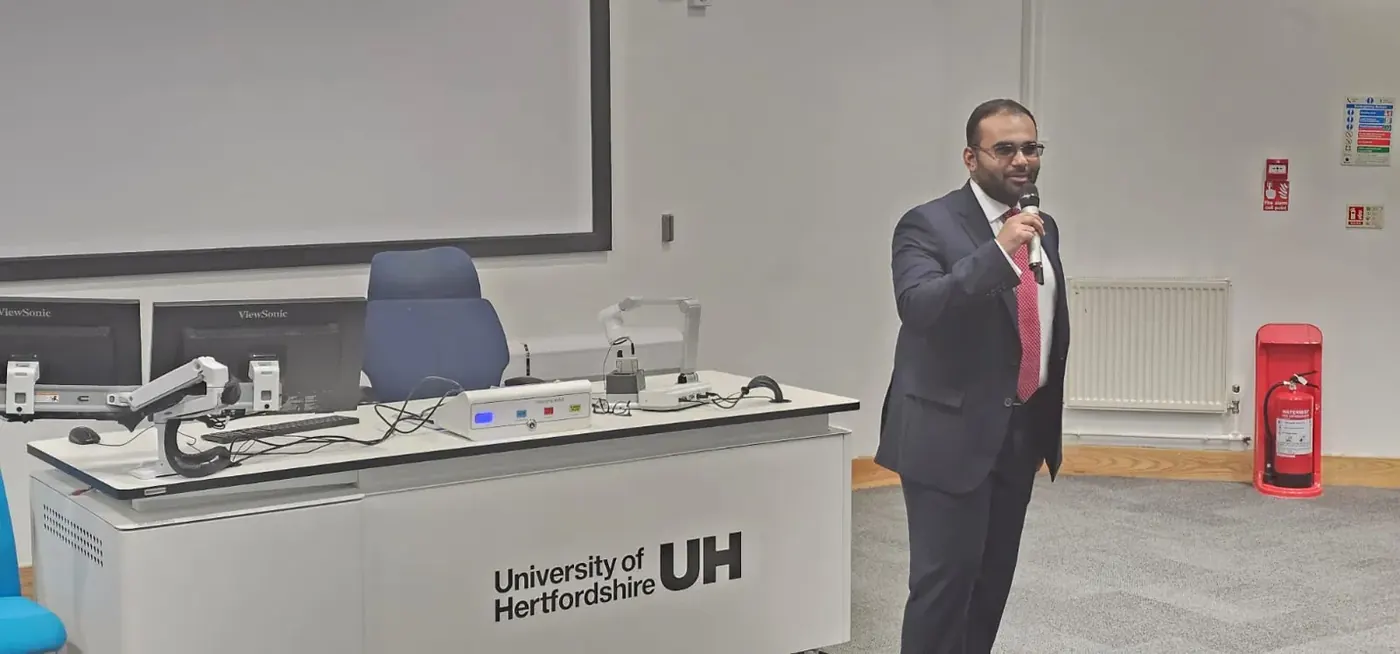
Munawar Kazmi presenting at the University of Hertfordshire
TALK · UNIVERSITY OF HERTFORDSHIRE

AI & Robotics in Education Conference

Presented on HRI and edge AI applications to students and faculty, with live robot demonstrations of the companionship research.
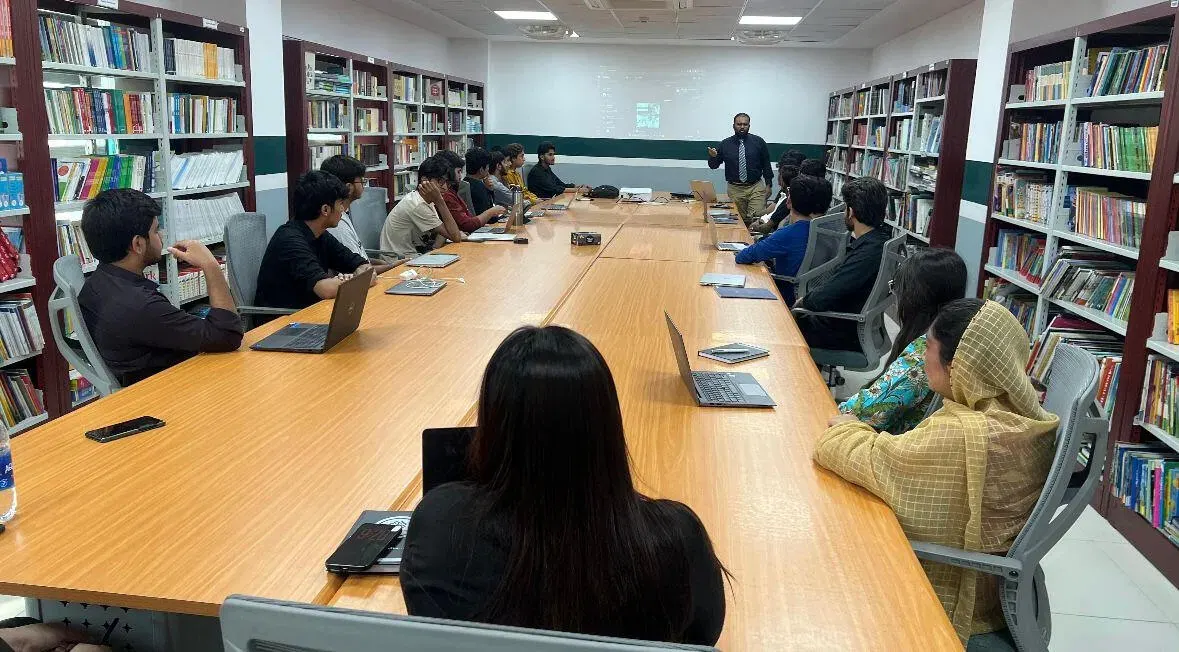
Munawar Kazmi leading a hands-on robotics and ML workshop at Pak-Turk Maarif Schools
WORKSHOP · PAK-TURK MAARIF SCHOOLS

Hands-On Robotics & ML Workshop

Led practical sessions covering gesture control, neural networks, and real-time AI deployment. Teams built and trained working classifiers during the session.
References
Munawar demonstrated remarkable technical proficiency, creativity, and a strong work ethic. He actively sought feedback and incorporated it into his work, demonstrating a commitment to continuous improvement. His innovative approach, coupled with a strong foundation in research and development, positions him as a valuable asset to academic or professional institutions.
Dr Patrick Holthaus
Reader in Interactive Assistive Technology · University of Hertfordshire · MSc Supervisor
Munawar demonstrated exceptional skill in embedded AI deployment during his contract at Muxtronics, leading the ESP32-CAM prototype from concept to a working product - a true asset for any robotics team.
Umer Waheed Bukhari
CEO · Muxtronics
He built the system that now runs this institute, and he built it by himself. Money cannot be quietly deleted: a wrong payment is corrected by a recorded reversal, so the record of what happened survives. And every change anyone makes is logged automatically. He proposed both of these himself. I did not ask for them, and I did not know to.
Irum Moin
Principal · Safina International · read the full reference (PDF)
GET IN TOUCH

Let's build
something real.

Open to PhD research collaboration in HRI and AI reliability, and to robotics and AI engineering roles in the UK, EU, and USA.

ACADEMIC & RESEARCH CONTACTS
Pursuing PhD opportunities in human-robot interaction and AI reliability. Happy to share full research proposals.
Email about research →
HIRING TEAMS
Open to robotics and AI engineering roles in the UK, EU, and USA. Sponsorship welcome.
Email about roles →
munawarsaeedkazmi1@gmail.com